Under construction: This page is still undergoing changes at the moment, but is mostly formatted (except for this heading) to meet its final intention of introducing viewers to projects I have been involved in, and then describing certain roles and functions I undertook as a member of those project teams.
STÆDIUM by Freeletics
2023 / Android & iOS
Title:
Orbital
Roles: Concept, Mechanics, UI/UX, Sound Direction, Level Design
Date:
August 2021 – May 2023
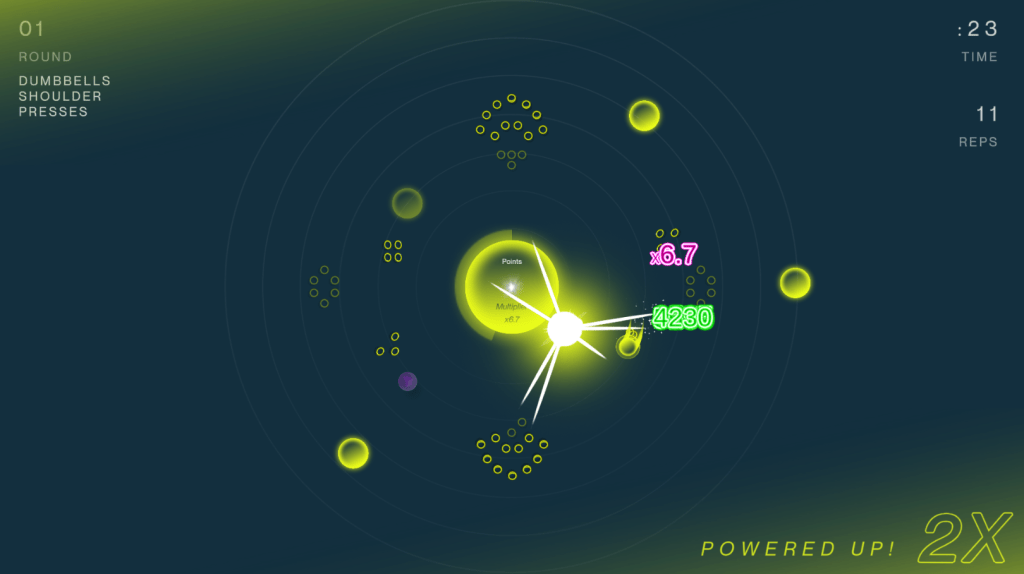
Transform your strength training into a captivating journey through dynamic and evolving levels.
Level Design for both STÆDIUM games, Dash and Orbital, were conceived upon the best exercise “flow” for each individual fitness movement. We had previous research and extensive knowledge on optimal in/out/interstitial stages of reps from Exercise Science department already, and began consulting with them on a bi-weekly basis. Nailing the understanding of what makes a proper, safe and productive workout versus one that is rushed, and that compromises safety or results helped to narrow down the variety of our designs and find ways to optimize the games so that their progression would serve as a form of player guidance, which was a design cornerstone we determined at the outset of development.
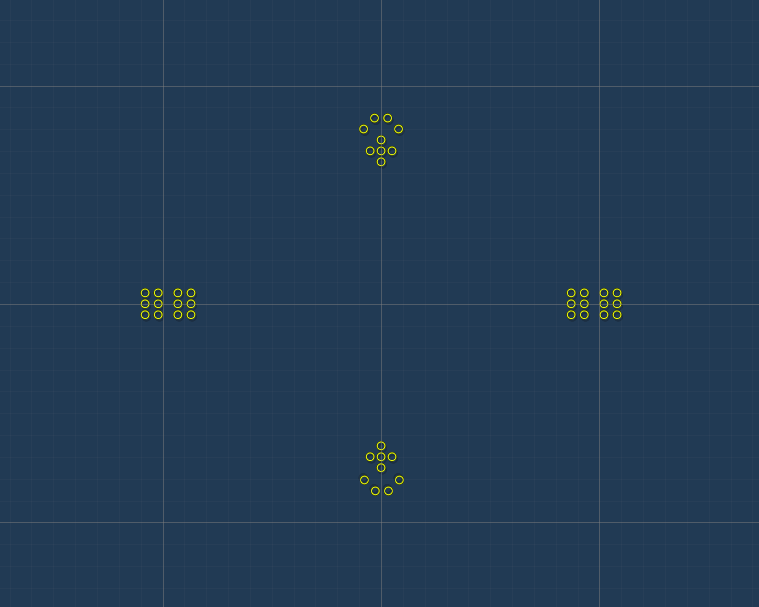
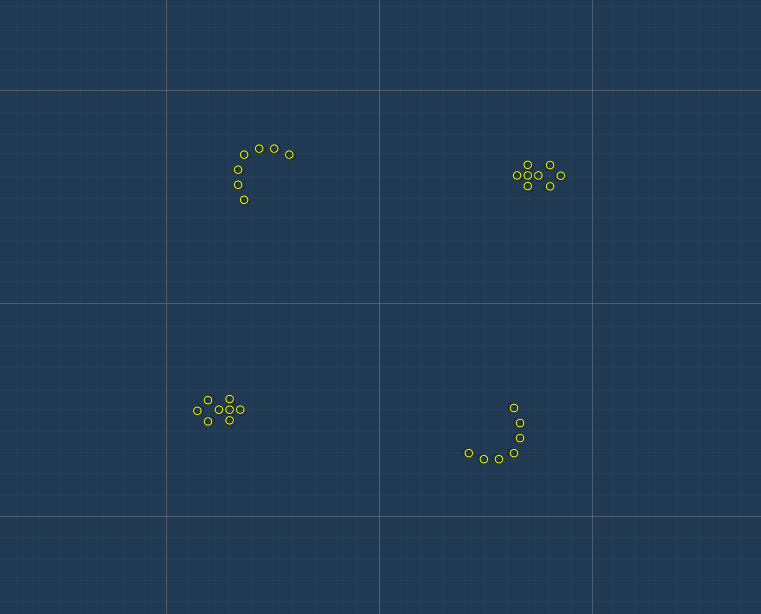
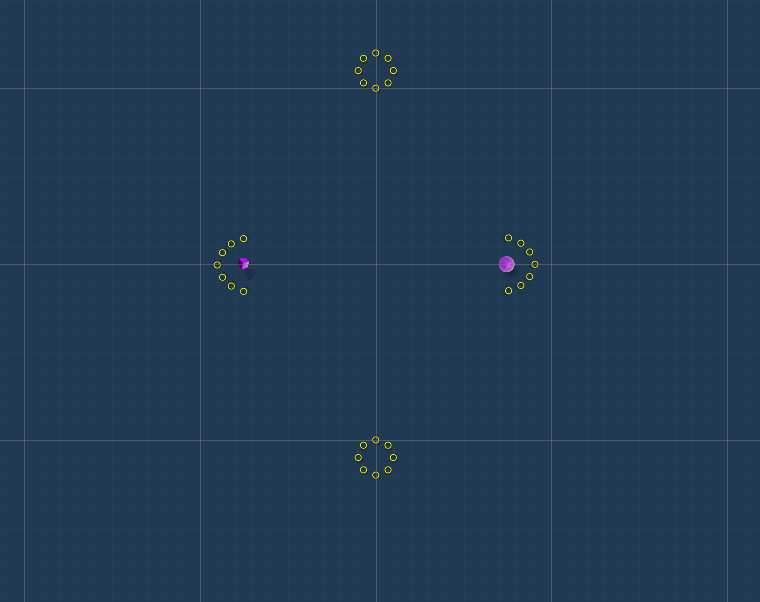
Players were intended to experience scenarios optimized to provide challenge and entertainment in addition to respecting screen attention deficits caused by exercise itself. In Orbital, the level design methodology was based on rewarding players for each successive rep made in a median tempo, and also their ability to apprehend, calculate, and respond to the collectibles and pitfalls arranged upon the game map. These game objects were spawned in waves, which gave players ever-changing points of focus in the game space. Just when spare rings were becoming more difficult to hit, new clusters would then appear, giving the impression of progression and giving new players new second-to-second goals.
Dumbbell Curls, with their relative simplicity forward-facing execution, were an excellent example of a basic fitness movement, and therefore enabled more experimental level design. Each wave challenged players with more pitfalls spread amongst more sparse groups powerups and collectibles, whereas Leg Lifts required a level design which focusing on larger groups of collectibles, with more numerous powerups.
The elegant rotational symmetry of the Orbital levels formed out of the desire to give players aesthetically pleasing landscapes to explore, with a focus on variety and replayability. Players who wished to focus less on the challenges and opportunities afforded by the game could still participate in the adventure of the experience without game skill or ‘ability’ being an influencing factor in their progression through the second-to-second journey. STÆDIUM is, after all, about motivating players through daily fitness, and THEN challenging them as gamers. Scores would of course determine the day-to-day or week-to-week journey, giving players incentive to challenge themselves to the same workouts, and see quantitative improvements over-time and increased effort.
see Orbitals in action:
Responsibilities included:



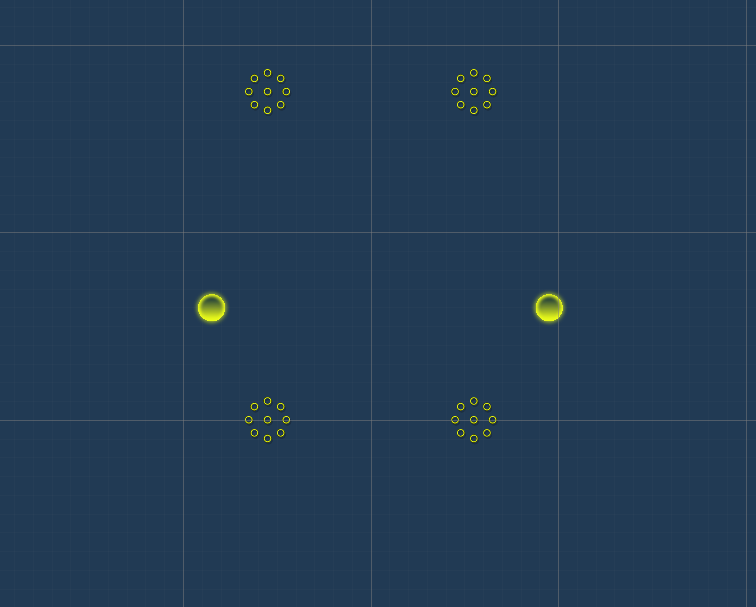
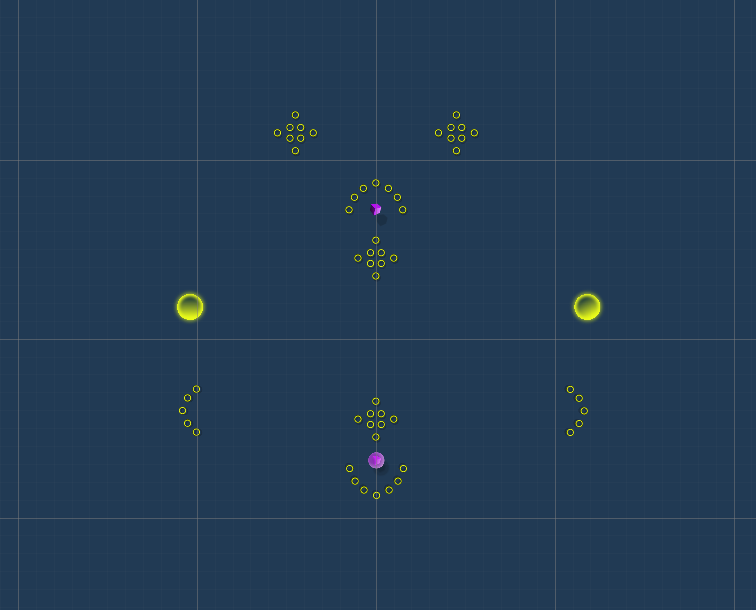
Level Design Notes
Situation:
During the development of ‘Orbital,’ we needed to create engaging level designs that matched the intensity and flow of different exercises. Dumbbell Curls, being a simpler forward-facing movement, presented an opportunity for more challenging level layouts.
Task:
My task was to design level waves for Dumbbell Curls (and all other exercises included in the launch of STÆDIUM), that would challenge players with increased challenge while maintaining a fun and engaging experience that did not distract from the fitness demands either.
Action:
I experimented with spawning object layouts to create waves with more pitfalls spread among sparser groups of powerups and collectibles. Much of this was done through trial-and-error, as in, I did not use automated algorithms and parameters, but rather followed product needs and player feedback to build level designs, and then test them myself (as an example of an ‘average’ player). I analyzed player testing data to observe how users reacted to these layouts, adjusting the spawn rates and patterns based on their feedback. I also paid close attention to the tempo of the exercise, ensuring the wave timings aligned with the player’s rep cadence.
Result: The resulting level designs for Dumbbell Curls provided a noticeable increase in challenge, and also enjoyment, leading to better player engagement and sense of accomplishment. Player feedback indicated they enjoyed the tactical element of navigating the constantly-evolving layouts. This design choice provided us two solutions in one: to first reduce the monotony of repetitive exercise with something that felt adventurous and dynamic, and also to include those game elements in a way which was not intrusive in terms of task difficulty, but that afforded us chances to build additional challenges or tasks when players would eventually demand it.
STAR Conclusion:
Orbitals’ level design methodology was initially built to respect players’ varying physical competencies and the subjectivity of what is fun and mentally stimulating, versus overwhelming. Although as a team, our long-term goals were to build algorithms which could manageme dynamic difficulty down to a much more granular level, we had to first take current team bandwidth limitations into consideration. Since STÆDIUM’s store debut was only months away, and many other vital components of the experience still being tied together, the task came upon me as game designer to conceptualize, build, test, and iterate on appropriate level designs for all exercises that would be a part of the game at launch (13 out of a total of 32). I found this task especially motivating, as it was sort of the result, or culmination of all the other work and decisions made in the months before. Now, the product of what we had been conceptualizing all this time was finally coming into full fidelity, and building/testing levels in this way just felt right. The work wasn’t even tedious despite the repetition, it was simply rewarding.

Title:
Dash
Roles: Concept, Mechanics and game mode enhancements, guidance UI/UX, Sound Direction, Bot Design and Scripting
Date:
August 2021 – May 2023
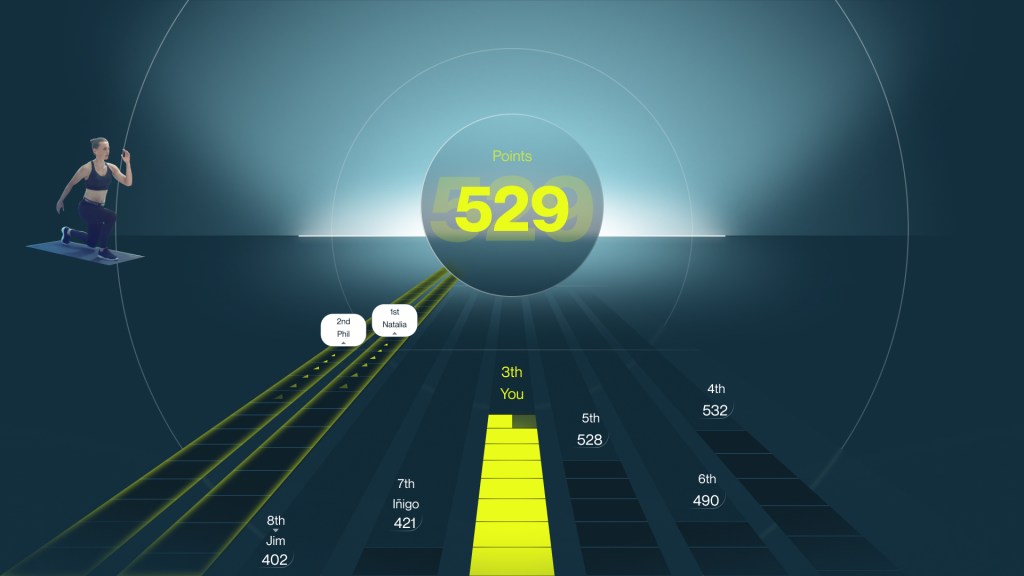
Experience a multi-lane race where your reps fuel your speed
DASH was the original STÆDIUM game experience. Before Orbital was put into development, we envisioned a multiplayer lane-racer that pitted players against one another and themselves was at the center of all of this. This stable, simple idea allowed us to explore, refine and verify nearly all of the product’s intended features. From game setup, goals, and scoring to real-time player guidance, preparation and rest periods, gamification, social aspects, and even the evolving audio-visual style of the STÆDIUM brand, DASH was our barometer for success. I was deeply involved in shaping DASH from every angle, with my most significant contributions being in the game’s visual design and UX, followed up with my scripting of the different AI bots which made the game fun to play at all skill levels.
We initially explored complex visual overlays and text combined with elaborate audio cue sequences to guide players. However, testing revealed that these elements were often confusing and detracted from the core gameplay. Similarly, we experimented with different visual styles and perspectives but ultimately opted for a cleaner, flatter, minimalist aesthetic that prioritized only the most essential game elements and aligned with the finalized branding decisions.
see Dash in action:
Level Design Notes
Situation:
During the development of ‘Orbital,’ we needed to create engaging level designs that matched the intensity and flow of different exercises. Dumbbell Curls, being a simpler forward-facing movement, presented an opportunity for more challenging level layouts.
Task:
My task was to design level waves for Dumbbell Curls (and all other exercises included in the launch of STÆDIUM), that would challenge players with increased challenge while maintaining a fun and engaging experience that did not distract from the fitness demands either.
Action:
I experimented with spawning object layouts to create waves with more pitfalls spread among sparser groups of powerups and collectibles. Much of this was done through trial-and-error, as in, I did not use automated algorithms and parameters, but rather followed product needs and player feedback to build level designs, and then test them myself (as an example of an ‘average’ player). I analyzed player testing data to observe how users reacted to these layouts, adjusting the spawn rates and patterns based on their feedback. I also paid close attention to the tempo of the exercise, ensuring the wave timings aligned with the player’s rep cadence.
Result: The resulting level designs for Dumbbell Curls provided a noticeable increase in challenge, and also enjoyment, leading to better player engagement and sense of accomplishment. Player feedback indicated they enjoyed the tactical element of navigating the constantly-evolving layouts. This design choice provided us two solutions in one: to first reduce the monotony of repetitive exercise with something that felt adventurous and dynamic, and also to include those game elements in a way which was not intrusive in terms of task difficulty, but that afforded us chances to build additional challenges or tasks when players would eventually demand it.
STAR Conclusion:
Orbitals’ level design methodology was initially built to respect players’ varying physical competencies and the subjectivity of what is fun and mentally stimulating, versus overwhelming. Although as a team, our long-term goals were to build algorithms which could manageme dynamic difficulty down to a much more granular level, we had to first take current team bandwidth limitations into consideration. Since STÆDIUM’s store debut was only months away, and many other vital components of the experience still being tied together, the task came upon me as game designer to conceptualize, build, test, and iterate on appropriate level designs for all exercises that would be a part of the game at launch (13 out of a total of 32). I found this task especially motivating, as it was sort of the result, or culmination of all the other work and decisions made in the months before. Now, the product of what we had been conceptualizing all this time was finally coming into full fidelity, and building/testing levels in this way just felt right. The work wasn’t even tedious at some point, it was simply rewarding.
 Portfolio - Alex Boccia